Wharfedale NOVA Subwoofers Scale From Compact Stereo to Large Home Cinemas
The four-model NOVA range combines long-throw drivers, down-firing passive radiators, DSP and Class D amplification in sizes from 8 to 15 inches.
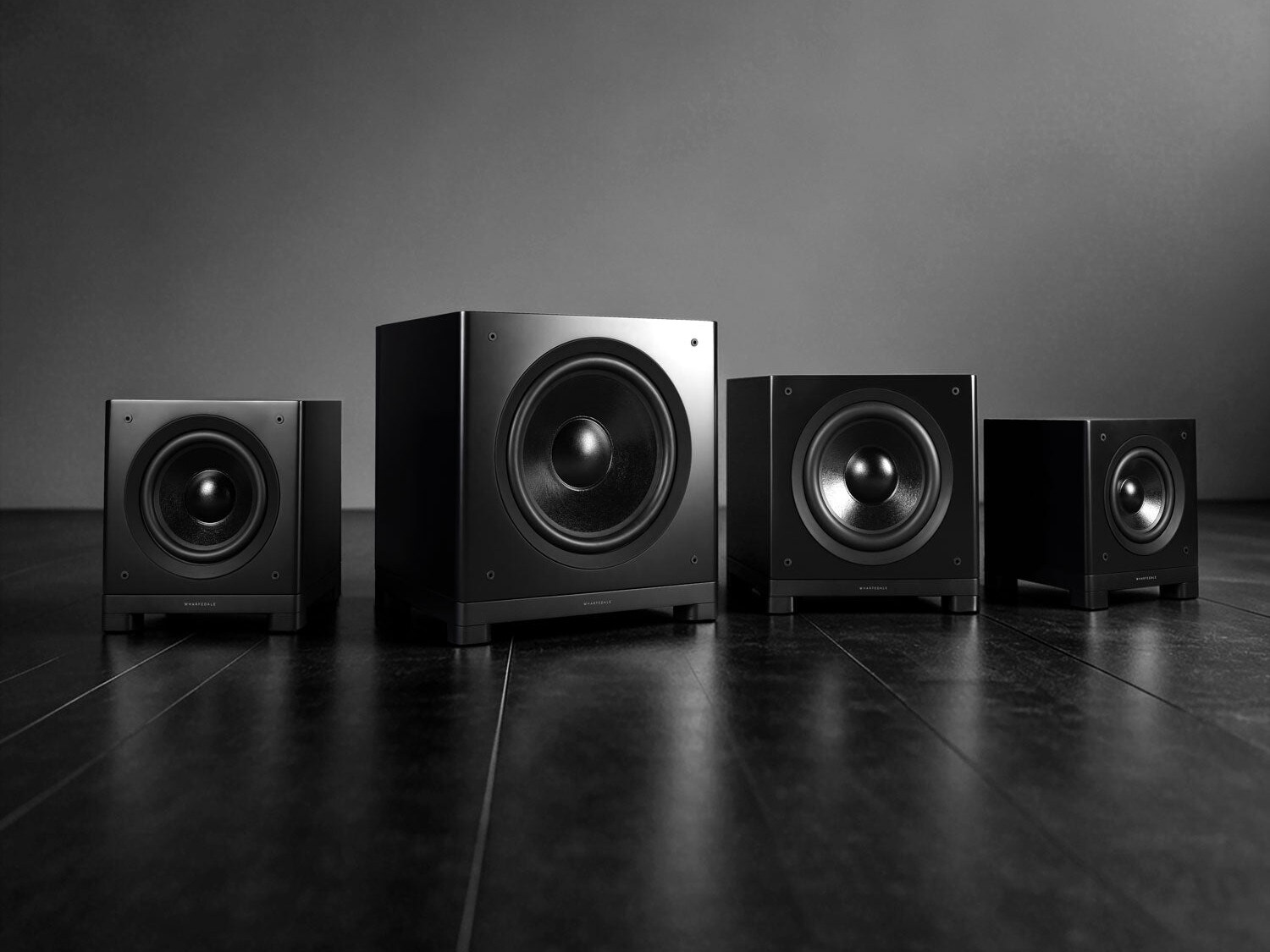
Wharfedale has introduced NOVA, a new family of four active subwoofers designed to cover systems ranging from compact stereo installations to large home cinemas. The line consists of the NOVA 8, NOVA 10, NOVA 12 and NOVA 15, with the model numbers identifying the nominal diameter of each active bass driver.
All four models follow the same basic architecture: a front-facing long-throw driver, a down-firing Auxiliary Bass Radiator, DSP-controlled equalisation and an integrated Class D amplifier. The differences are principally scale, amplifier output and low-frequency reach. That gives buyers a consistent design to work with while allowing the cabinet to be matched more closely to the room and listening level.
The NOVA range is scheduled to reach the UK market in late September. Pricing starts at £799 for the NOVA 8 and rises to £899 for the NOVA 10, £1,099 for the NOVA 12 and £1,299 for the NOVA 15. All four initially come in a single matt-black finish.
One platform, four room sizes
The NOVA 8 is the compact entry point, intended for smaller rooms, desktop systems and discreet cinema installations. The NOVA 10 moves into small-to-medium spaces, while the NOVA 12 is aimed at rooms that need greater output and low-frequency scale. The NOVA 15 sits at the top of the family for larger listening areas and more demanding playback levels.
Cabinet size increases substantially across the range. The published dimensions place the NOVA 8 at 348 × 320 × 361 mm, the NOVA 10 at 391 × 363 × 408 mm, the NOVA 12 at 443 × 435 × 487 mm and the NOVA 15 at 549 × 540 × 607 mm. The largest model is therefore not simply a slightly wider alternative: it occupies far more floor space and will need deliberate placement in a living room or dedicated theatre.
Wharfedale has paired each active driver with a down-firing passive radiator rather than a conventional open reflex port. The NOVA 10, 12 and 15 use a radiator corresponding to their driver size, while the smaller NOVA 8 incorporates the same 10-inch radiator used by the NOVA 10. The passive element is intended to extend bass response without the airflow noise and compression that can affect a port at high output.
That design choice does not remove room interaction. Boundary reinforcement, standing waves and the relationship between the subwoofer and listening position will still shape the result. The down-firing radiator also means the floor and the clearance beneath the cabinet form part of the acoustic environment, so thick carpet, uneven flooring or a cramped platform may affect how cleanly the system behaves.
DSP and amplification are integrated with the driver
The four cabinets use Class D amplifiers rated at 200W, 230W, 280W and 360W respectively. Peak output is listed at 500W for the NOVA 8 and NOVA 10, increasing to 770W for the NOVA 12 and NOVA 15. Those figures describe electrical capability rather than audible performance on their own; driver displacement, enclosure loading, DSP limits and the room remain equally important.
The active drivers use rigid, coated paper cones, large-diameter voice coils and aluminium shorting rings in the motor systems. The shorting rings are intended to improve linearity and reduce distortion as the driver moves through its operating range. Wharfedale has developed the driver, amplifier, cabinet loading and signal processing as a complete system rather than treating the electronics as a separate add-on.
Two DSP-controlled operating modes adapt the response for music or cinema use. The music setting is intended to favour integration and control, while the cinema mode gives low-frequency effects more scale and impact. Dynamic equalisation is also part of the signal chain, allowing the subwoofer to manage its response as output demands change.
Published low-frequency extension varies from 33Hz on the NOVA 8 to 28Hz on the NOVA 12 and NOVA 15. The NOVA 10 sits between them. The identical 28Hz figure for the two largest models suggests that the NOVA 15's main advantage may be output capability and headroom rather than deeper quoted extension. Room gain may extend usable in-room bass below those figures, but buyers should not read driver diameter alone as a promise of lower frequency reach.
Connections cover stereo and cinema systems
Each model provides both low-level and high-level inputs, allowing it to work with an AV receiver, a stereo preamplifier or an amplifier without a dedicated subwoofer output. A 12V trigger supports coordinated power control in installed systems, while a USB connection is reserved for firmware updates.
Rear-panel adjustments include crossover frequency, phase and level. The shared crossover range is listed as 40Hz to 160Hz. In a home-cinema system, bass management in the AV receiver will usually handle the main crossover, but the onboard controls remain useful for stereo installations and for systems without full room correction.
The specification does not include app control or automatic room equalisation. Setup therefore remains a manual process unless the connected receiver or processor supplies its own measurement and correction system. At these prices, that omission is notable because several competing subwoofers use an app to simplify level matching, phase adjustment, parametric EQ and listening presets.
What the NOVA range changes in Wharfedale's line-up
NOVA gives Wharfedale a coherent subwoofer family positioned above a basic add-on for bookshelf speakers. The common industrial design and wide size range make it possible to choose for output and room volume without moving to a different control scheme or acoustic concept.
The range also makes its priorities clear. Passive-radiator loading, integrated DSP and music/cinema modes point toward controlled, adaptable bass rather than a single headline extension figure. The trade-off is that buyers still need to handle placement and calibration carefully, and the absence of app-based tuning leaves more of that work to the AV receiver or to manual measurement.
The NOVA 8 and NOVA 10 look suited to mixed-use rooms where cabinet size matters, while the NOVA 12 is likely to be the more natural starting point for a dedicated cinema. The NOVA 15 adds physical scale and potential output, but its published extension does not go below the NOVA 12's 28Hz figure. Its case will therefore depend on how much additional clean headroom it can deliver in a large room once production units become available.
Related Reading
XGIMI Unveils HORIZON 30 Series: 4K at 120Hz, Dual Iris Technology, and Up to 10,000:1 Native Contrast
XGIMI unveils the HORIZON 30 Pro, Max, and Ultra Max with RGB triple laser, 4K 120Hz, Dual Iris technology, and major contrast improvements.
Apple Music Hall Will Stream Concerts Globally From a 48-Speaker Spatial Audio Venue
Apple's new 600-capacity London venue combines Spatial Audio production, multicamera capture and global livestreaming, but home playback formats remain unannounced.
Epson Brings Three 4K Laser Projectors to the US From $1,999
The Home Cinema LS5000, LS6000 and short-throw LS7500 combine 3LCD laser engines, 4K/120Hz input and prices from $1,999.99.