Apple Music Hall Will Stream Concerts Globally From a 48-Speaker Spatial Audio Venue
Apple's new 600-capacity London venue combines Spatial Audio production, multicamera capture and global livestreaming, but home playback formats remain unannounced.
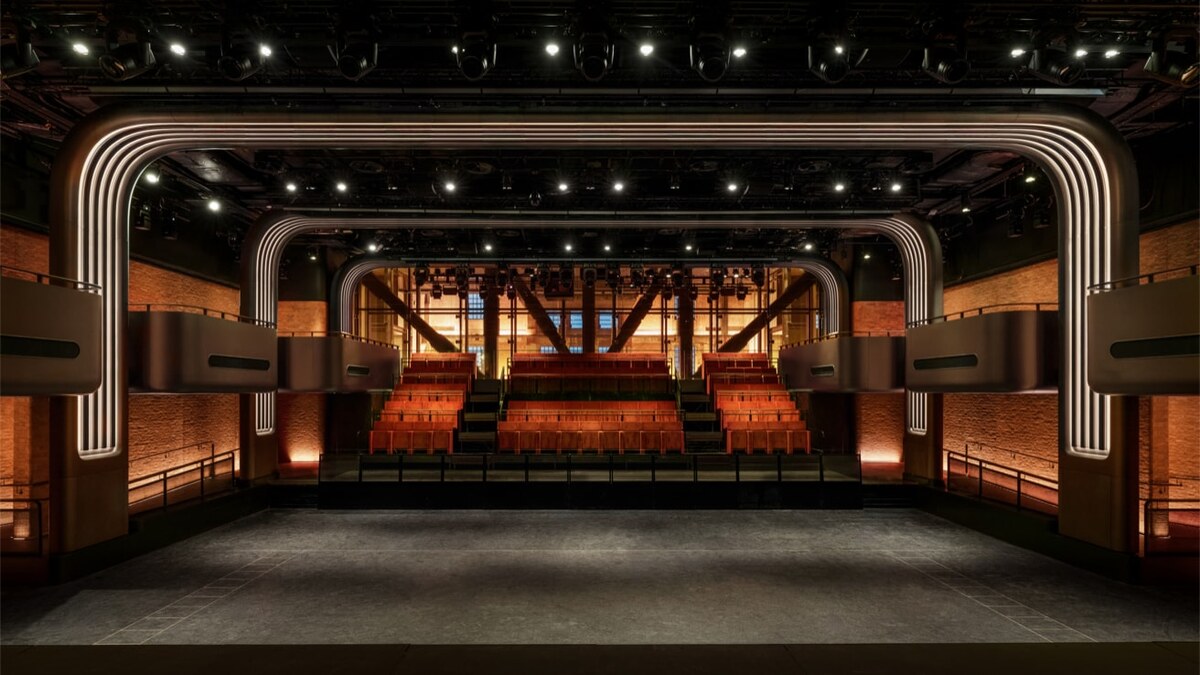
Apple has introduced Apple Music Hall, a purpose-built live venue at Battersea Power Station in London that combines an intimate performance space with end-to-end audio and video production. The 600-capacity hall is equipped to record multitrack audio, create Spatial Audio mixes, capture performances with more than 16 cameras and livestream shows to a global audience.
The dedicated venue site lists September 28 as its opening date. Artists and individual performances have not yet been announced, and neither has a public streaming schedule. Even so, the production infrastructure is already significant for home entertainment: Apple is building live concerts around immersive sound and broadcast-ready video at the point of capture instead of treating those elements as later additions.
That distinction could matter to viewers with an Apple TV, compatible smart television, soundbar or multichannel system. A performance recorded and mixed for immersive playback has a more direct path to the living room than one created primarily for a conventional stereo broadcast. However, the venue's Spatial Audio production capability and its global livestreaming capability should not yet be assumed to describe the same consumer stream. Apple has not disclosed the playback platform, video resolution, HDR format, delivered audio format or device requirements for the livestreams.
A venue designed as a production system
Apple Music Hall is not simply a stage with cameras added around it. Two dedicated recording and mixing studios sit behind the performance area, allowing a show to be captured as a multitrack recording and mixed in Spatial Audio either live or after the performance. The facility also includes a broadcast control room and permanent connections for at least 16 cameras.
The camera infrastructure can accommodate conventional broadcast equipment while supporting iPhone capture in parallel. That gives production teams multiple ways to frame a performance, from polished multicamera coverage to more mobile shots that can move through the venue. The resulting material can be prepared as a broadcast-ready mix and multicamera video without moving the production to a separate post-recording facility.
This integrated workflow is the most important part of the announcement for remote viewers. Live concert streams often have to balance what works in the room with what can be delivered reliably outside it. Here, the venue itself has been designed around both audiences. The physical show and the remote version share the same recording, mixing and control infrastructure from the start.
The opening does not guarantee that every performance will be livestreamed or released later. It does establish that global streaming is part of the venue's intended operation rather than an occasional external production brought in for selected events.
Spatial Audio begins with 48 speakers in the room
Inside the hall, a 48-speaker spatial sound system surrounds the audience. Performances can therefore be presented immersively to people at the venue while the same event is captured as separate audio elements for recording and mixing.
The distinction between the in-room speaker system and the home mix is important. Forty-eight physical speakers in London do not translate into a requirement for 48 speakers at home. Consumer Spatial Audio delivery is normally adapted to the playback system, whether that is a Dolby Atmos-capable AV receiver and speaker layout, a soundbar, headphones or a device using virtualisation. The final options for Apple Music Hall streams remain unknown because no consumer delivery specification has been published.
The venue's production chain nevertheless removes an obvious limitation. A concert cannot offer a convincing object-based or spatial mix if the required sources were never isolated and captured. Multitrack recording and dedicated mix rooms provide the raw material needed to place vocals, instruments, audience sound and room ambience deliberately rather than expanding a finished stereo feed after the event.
Apple Music already distributes music in Spatial Audio with Dolby Atmos, but the new hall has not yet been tied to a specific catalogue format or release policy. It could support live broadcasts, on-demand concert videos, audio-only releases or several versions of the same performance. Those possibilities are technically plausible; none should be treated as announced programming until Apple provides the schedule and delivery details.
The stage can change with the production
The 38-foot-wide stage can be configured for a conventional front-facing performance or adapted for an in-the-round layout. Seating can also be arranged around the needs of a particular show. This flexibility affects more than the experience inside the hall because camera placement, sightlines and sound design all change when the performer moves from one end of the room to its centre.
A fixed broadcast studio can produce consistent results, but it can also make every performance look similar. Apple Music Hall instead combines permanent production infrastructure with a reconfigurable room. If the system is used fully, streams could preserve more of each artist's chosen staging while retaining controlled audio and video capture.
The building itself forms part of the visual design. Brickwork, bronze-coloured balconies, illuminated arches and views into the restored power station give the venue a recognisable identity without relying on a large arena. The 600-person capacity also keeps the audience physically close to the stage, which should help the remote presentation retain crowd energy without the scale of a stadium production.
Global livestreaming is planned, but the delivery chain is unknown
Performances from Apple Music Hall will be livestreamed globally. That is the clearest consumer-facing promise in the announcement, yet the practical details are still unusually open.
No artist lineup, ticket process or first broadcast date has been published. Apple has not identified whether viewers will watch through Apple Music, the Apple TV app, a dedicated event page or several services. Resolution, frame rate, dynamic-range format, bitrate and the audio codec for home playback also remain unspecified.
The absence of those details matters. A venue may create a finished Spatial Audio mix while a particular livestream is delivered in stereo for reach or bandwidth reasons. Conversely, a later on-demand release could carry a more advanced soundtrack than the live version. Until the consumer specification is announced, the safe conclusion is that Apple Music Hall can produce immersive audio and global video streams—not that every remote viewer will automatically receive the full venue mix.
Device support is equally unresolved. Apple Music is available across Apple TV, smart televisions, game consoles, mobile devices and computers, while Spatial Audio playback support varies by platform and connected audio hardware. The eventual distribution route will determine whether the project is primarily an Apple-device experience or a broader live-music service accessible on common television platforms.
New Apple Music Radio studios share the location
Apple Music Radio's London-based hosts and programmes are moving into new studios at Battersea alongside the hall. That places interviews, radio sessions, live performances and concert production within one facility.
The arrangement could shorten the route from an artist appearance to a finished programme. A performer can take part in a radio session, move into the hall for a show and leave with multitrack audio and multicamera video captured under one roof. It also gives the venue a regular production role between major concerts instead of limiting its use to ticketed evening events.
For audiences, the radio move indicates that Apple Music Hall is intended to operate as a continuing content facility rather than a branded room used only for occasional launches. The scale of that output will become clearer when the first programme schedule is published.
What this changes for home entertainment
The immediate change is not a new app or a new playback format. It is the creation of a dedicated source for live music content where immersive audio, multicamera video and global distribution are planned together.
For a home-cinema system, the eventual value will depend on delivery. A high-quality 4K stream with HDR and a discrete immersive soundtrack would make the venue a compelling showcase for large displays, projectors and multichannel audio. A compressed stereo livestream would still provide access to the performance, but it would leave much of the production system's home-theatre potential unused.
Apple Music Hall therefore arrives with strong production foundations and deliberately incomplete consumer details. The venue includes 48 speakers, multitrack studios, an adaptable stage, a broadcast control room and a permanent camera network. The first artists, stream dates, viewing platform and home audio-video formats remain unannounced.
Those missing details are now the dividing line between an impressive London venue and a genuinely new premium concert-streaming proposition. The hardware and workflow are ready to create the latter; the first broadcasts will show how much of that capability reaches viewers at home.
Related Reading
XGIMI Unveils HORIZON 30 Series: 4K at 120Hz, Dual Iris Technology, and Up to 10,000:1 Native Contrast
XGIMI unveils the HORIZON 30 Pro, Max, and Ultra Max with RGB triple laser, 4K 120Hz, Dual Iris technology, and major contrast improvements.
Epson Brings Three 4K Laser Projectors to the US From $1,999
The Home Cinema LS5000, LS6000 and short-throw LS7500 combine 3LCD laser engines, 4K/120Hz input and prices from $1,999.99.
Yamaha B200A Brings Dolby Atmos to Desks and Smaller TVs
The 60cm all-in-one combines virtualized Dolby Atmos, a built-in three-inch subwoofer and HDMI eARC in a cabinet designed for bedrooms, offices and gaming setups.