Epson Brings Three 4K Laser Projectors to the US From $1,999
The Home Cinema LS5000, LS6000 and short-throw LS7500 combine 3LCD laser engines, 4K/120Hz input and prices from $1,999.99.
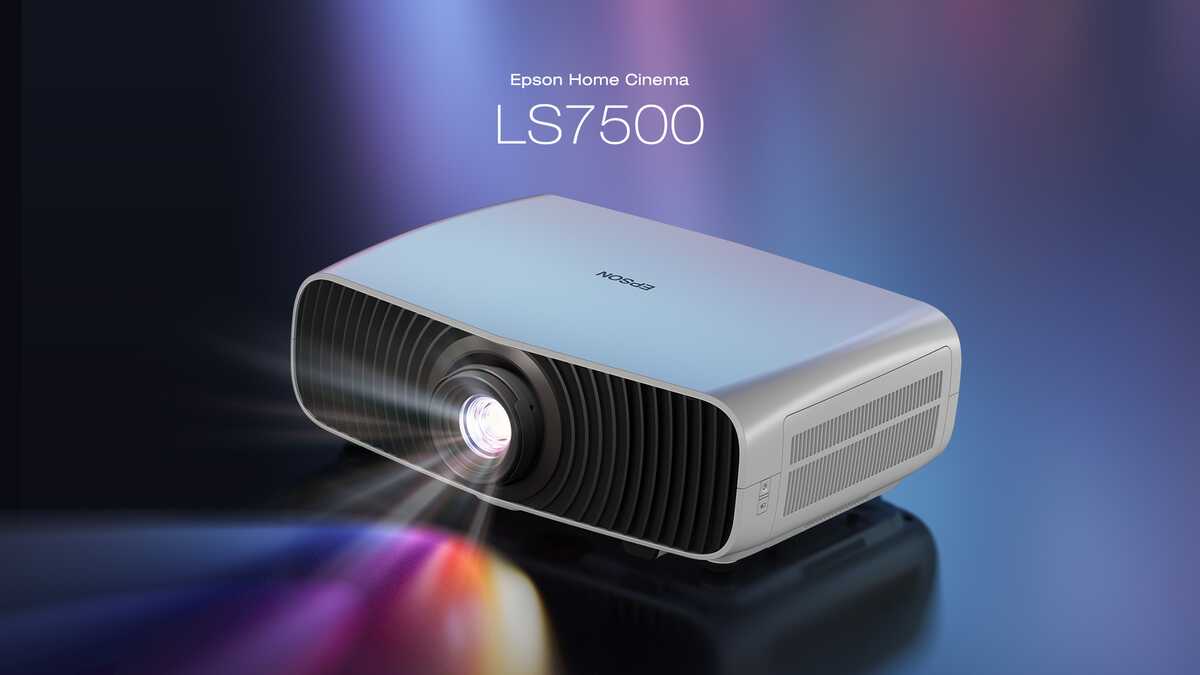
Epson has launched three Home Cinema laser projectors in the United States, filling the space between entry-level living-room models and the company's more elaborate premium installations. The Home Cinema LS5000 costs $1,999.99, the brighter LS6000 costs $2,199.99, and the short-throw LS7500 sits at the top of the trio for $2,699.99.
All three are available through Epson's US store and selected retailers. Their shared platform combines a three-chip 3LCD laser light engine, 4K input support at up to 120Hz, HDR processing and a manual lens system. They also omit built-in speakers and smart-TV software, making them purpose-built display components rather than self-contained streaming projectors.
The family is unusually easy to understand. The LS5000 establishes the price floor, the LS6000 raises brightness without changing the standard-throw installation model, and the LS7500 adds both a little more output and a shorter lens for rooms where the projector must sit closer to the screen. Buyers are therefore choosing primarily between light output and placement flexibility rather than three completely different feature sets.
Three brightness levels, two lens strategies
The LS5000 is rated at 2,500 lumens for both white and colour brightness. The LS6000 increases that figure to 3,400 lumens, while the LS7500 reaches 3,500 lumens. These are manufacturer ratings rather than independent measurements, but the step from the LS5000 to the LS6000 is large enough to define how Epson expects the models to be used.
At 2,500 lumens, the LS5000 is positioned most naturally for controlled-light rooms and conventional evening viewing. The LS6000's higher rating gives it more headroom for larger images, moderate ambient light and HDR highlights, while the LS7500 combines a similar brightness target with a lens designed for shorter projection distances.
The LS5000 and LS6000 have a throw-ratio range of 1.32–2.15:1. The LS7500 changes that to 1.0–1.3:1, allowing the same image width from a meaningfully shorter distance. It remains a short-throw projector rather than an ultra-short-throw model, so it still faces the screen from the audience side of the room and does not replace the furniture-level placement of a laser TV.
Each projector supports image sizes from 40 to 300 inches. The lens shift range is rated at plus or minus 59 per cent vertically and plus or minus 21 per cent horizontally, accompanied by manual zoom and focus. That shift flexibility should make ceiling and shelf installations easier, although the manual controls mean there is no powered lens memory for quickly switching between different aspect ratios or saved screen positions.
4K/120Hz input without native-4K imaging panels
The three projectors use Epson's 4K Display Technology to place 8.29 million pixels on the screen. The system starts with 1080p imaging panels and uses rapid pixel shifting to produce the full 4K pixel count. That is a different architecture from a native-4K imaging device, even though the resulting frame contains the same number of addressable on-screen pixels.
Using three LCD panels also means red, green and blue are displayed simultaneously. There is no sequential colour wheel of the type used by many single-chip DLP projectors, so the platform avoids the rainbow artefacts that some viewers notice on high-contrast motion.
Both HDMI inputs use the HDMI 2.1 specification, and one supports eARC. The projectors accept 4K signals at up to 120Hz and include Auto Low Latency Mode. Epson rates input lag at under 20 milliseconds with a 4K/60Hz signal. The figure is not a substitute for measured latency across every mode, but it puts gaming high on the intended-use list rather than treating it as a secondary capability.
The 4K/120Hz input is particularly useful for current consoles and gaming PCs, yet buyers should keep the imaging architecture in mind. Signal compatibility and panel resolution are separate questions: these models can receive a high-frame-rate 4K source, while their 4K picture is created through pixel shifting rather than native-4K panels.
HDR adjustment is automatic, but format support stays focused
HDR10 and HLG are supported across the range. Epson has also included AI-controlled HDR adjustment, which analyses incoming material and varies the HDR presentation rather than relying on one fixed curve for every scene. The practical aim is to retain more highlight and shadow detail within the lower light-output envelope of projection.
That processing could be important because projector HDR performance depends heavily on image size, screen gain and room conditions. A tone-mapping choice that works for a 100-inch screen may be too dark at 150 inches. Automated analysis can reduce the need for constant manual intervention, but the final result will still depend on installation and calibration.
The confirmed format list does not include Dolby Vision or HDR10+. That keeps the emphasis on HDR10 playback and Epson's own adjustment system. It also makes an external source device, AV receiver or processor the centre of the playback chain, since the projectors have no integrated streaming platform.
Bluetooth audio output is available, although the HDMI eARC connection is the more appropriate route for a permanent home-cinema system. None of the models has built-in speakers, so every installation needs a separate sound solution from the start.
Manual installation helps contain the price
The LS5000 and LS6000 measure 17.3 by 6.3 by 12.4 inches and weigh 17.6 pounds. The LS7500 is slightly deeper at 13.1 inches and weighs 18 pounds. These are manageable dimensions for a serious home projector, but the lack of powered lens controls distinguishes the series from more expensive installation models.
That choice brings both benefits and trade-offs. Manual zoom, focus and shift can be perfectly adequate for a fixed 16:9 screen, and they help keep the LS5000 just below the $2,000 threshold. They are less convenient for a constant-image-height setup in which the lens must move between 16:9 and wider cinema presentations.
The laser light source is rated for up to 20,000 hours, eliminating routine lamp replacement. Maximum operating noise is listed at 25dB. Both figures are published specifications rather than test results, and operating mode will influence real-world brightness, fan noise and useful light-source life.
The LS7500 adds PJLink support plus Control4 and Crestron Home integration, features not listed for the LS5000 or LS6000. Combined with its shorter throw, those controls make the top model the most installation-oriented option even though it shares the family's manual lens operation.
How the three models divide
The LS5000 is the value model. Its 2,500-lumen rating is the lowest of the three, but it preserves the core laser engine, 4K/120Hz input, dual HDMI 2.1 connections, broad lens shift and 300-inch maximum image size. For a dark room with a fixed screen, it offers most of the platform at the lowest price.
The LS6000 asks another $200 for a substantial claimed brightness increase to 3,400 lumens. It keeps the same standard-throw lens and cabinet dimensions, making it the straightforward choice for buyers who have enough projection distance but want more flexibility with screen size or ambient light.
The LS7500 costs $500 more than the LS6000. Its extra 100 lumens are unlikely to be the deciding factor. The meaningful upgrades are the 1.0–1.3:1 short-throw lens and home-control integration, which can solve placement problems and make the projector easier to incorporate into a professionally controlled room.
All three carry the same 800,000:1 dynamic contrast rating on the LS5000 and LS6000, rising to 1,000,000:1 on the LS7500. Dynamic contrast figures describe an active system and should not be read as native panel contrast. Dark-room testing will be needed to show how much visible black-level separation exists between the models.
What the US launch changes
The new Home Cinema range gives US buyers a clear laser upgrade path beginning at $1,999.99. It also brings features once concentrated in higher-priced projectors—including 4K/120Hz input, a long-life light source and wide lens shift—into a more accessible part of the market.
The design priorities are equally clear. These are display-first machines, with no smart platform, no integrated sound and no ultra-short-throw convenience. They suit buyers who already have sources and audio covered, and who want a conventional screen-based system with more installation freedom than a lifestyle projector usually provides.
The LS6000 may be the centre of gravity in the line because its $200 premium buys the largest brightness jump. The LS5000 remains the price-led dark-room option, while the LS7500 earns its position through room geometry and control support rather than a dramatic picture-specification advantage.
Independent testing will determine how the three compare in contrast, calibrated brightness, HDR tone mapping, motion and gaming latency. On confirmed specifications alone, however, the US launch creates a focused three-model range with sensible separation—and places a 4K/120Hz-capable 3LCD laser projector just below $2,000 for the first time in this family.
Related Reading
XGIMI Unveils HORIZON 30 Series: 4K at 120Hz, Dual Iris Technology, and Up to 10,000:1 Native Contrast
XGIMI unveils the HORIZON 30 Pro, Max, and Ultra Max with RGB triple laser, 4K 120Hz, Dual Iris technology, and major contrast improvements.
Apple Music Hall Will Stream Concerts Globally From a 48-Speaker Spatial Audio Venue
Apple's new 600-capacity London venue combines Spatial Audio production, multicamera capture and global livestreaming, but home playback formats remain unannounced.
Yamaha B200A Brings Dolby Atmos to Desks and Smaller TVs
The 60cm all-in-one combines virtualized Dolby Atmos, a built-in three-inch subwoofer and HDMI eARC in a cabinet designed for bedrooms, offices and gaming setups.