TCL enters the European projector market with the PlayCube, A1s and C1
Three Google TV projectors, the 799-euro PlayCube, 399-euro A1s and 299-euro C1, take TCL into continental Europe at the bottom and middle of the category rather than the top.
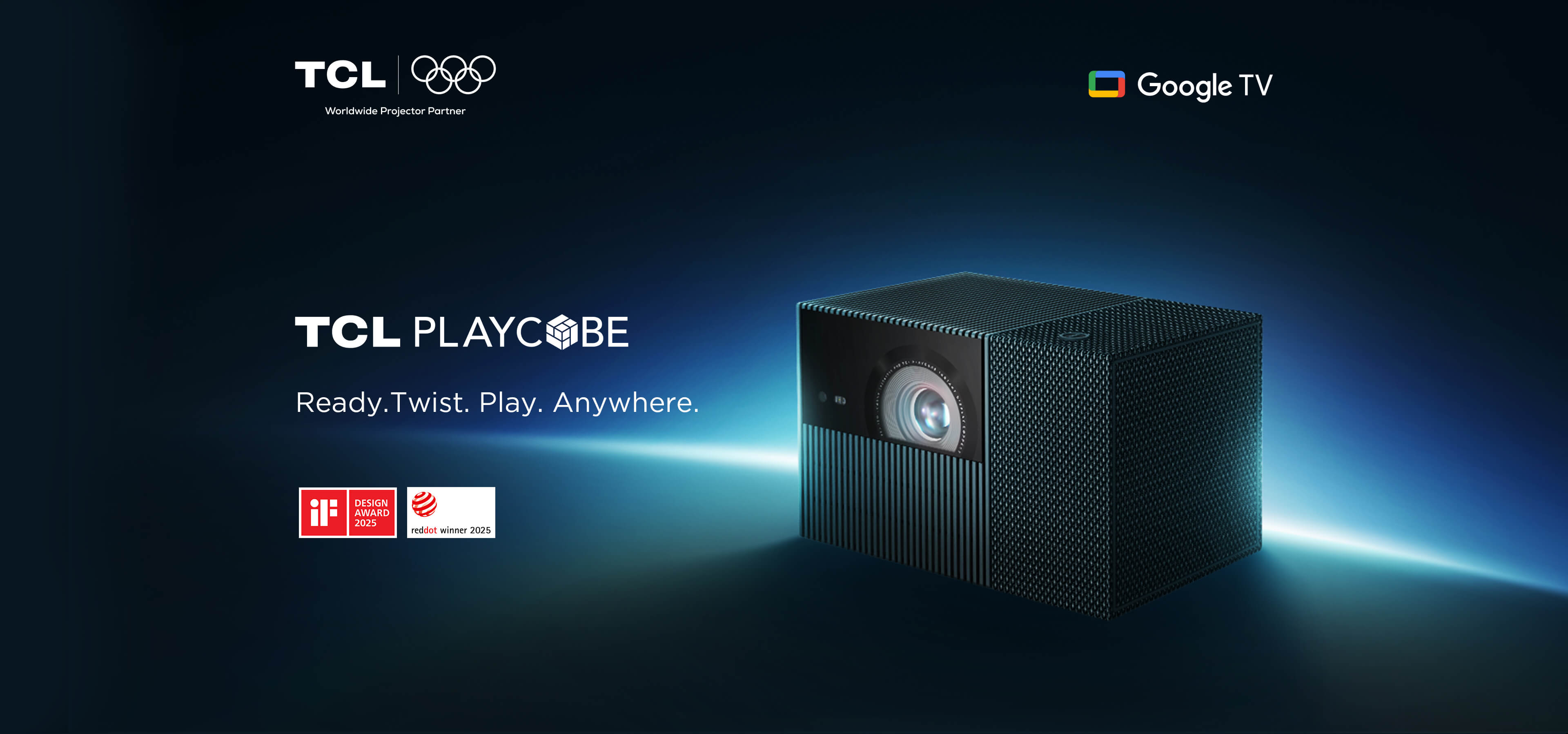
Three Full HD Google TV projectors are TCL's way into continental Europe: the PlayCube at 799 euros, the Projector A1s at 399 euros and the Projector C1 at 299 euros. All three accept 4K input, and all three are positioned as portable or easily movable devices rather than fixed home cinema installations.
This is a market entry rather than a single product launch. TCL is not arriving with a flagship triple-laser UST to compete with Hisense or Samsung. It is arriving at the bottom and middle of the category, where volume lives, using the same Google TV software strategy it has spent years building into its televisions.
One clarification on the framing: the UK saw these models first, with the PlayCube listed at £799.99, the A1S at £369.99 and the C1 at £249.99. The June rollout extends that range across the rest of the region.
PlayCube: the rotating cube is the halo product
The PlayCube is the model TCL is leading with, and the one carrying the design story. It is a 95 x 95 x 145 mm block weighing 1.36 kg, built so the front section twists up to 90 degrees against the body. That lets the lens point at a wall, a ceiling or a tent roof without repositioning the whole chassis or leaning on digital correction.
TCL specifies a 0.33-inch TI DMD, an Osram three-colour LED light source, 750 ISO lumens, a 30 to 150 inch image range and 124 percent of Rec.709 coverage. A 66 Wh battery is built in. TCL claims up to three hours of cordless playback; French retail listings quote 2.5 hours, so treat the runtime figure as mode-dependent. Quoted noise is 26 dB.
A1s and C1 use LCD, not DLP
The two cheaper models are a different class of device, and the spec sheets say so plainly. The A1s uses a 4.45-inch LCD panel rated at 600 ISO lumens, with a 45 to 150 inch range, dual 8 W speakers and a "VersaGrip" handle that doubles as a stand with 0 to 15 degrees of tilt. The C1 uses a 3-inch LCD panel at 230 ISO lumens, covers 40 to 120 inches, weighs 1.77 kg and sits on a 285-degree gimbal.
That LCD-versus-DMD split matters more than the lumen gap. Small LCD engines typically trail DLP on contrast and pixel definition, so the A1s and C1 are casual dark-room devices rather than cheaper PlayCubes.
Google TV pre-installed and Netflix certification on all three models removes the most common annoyance in this price band, where certification gaps often force buyers to add a streaming stick. The pricing is aggressive rather than exploratory.
Contrast is absent, and the light-source life disagrees with itself
Contrast ratio is absent across all three models, and it is the specification that most determines how they look on real content. TCL also quotes light-source life inconsistently: its own C1 page claims 30,000 hours while French coverage lists 10,000 hours for the same LED engine. Nothing has been published about input lag, and the 230-lumen C1 raises an obvious question about use before nightfall.
The PlayCube is still the product with a story: RGB LED, a real DMD, a battery and a useful rotation mechanism. The A1s and C1 look like conventional budget LCD projectors with better software than usual.
Sources
- https://www.tcl.com/global/en/projectors/playcube
- https://www.tcl.com/global/en/projectors/a1s
- https://www.tcl.com/global/en/projectors/c1
- https://blog.son-video.com/en/2026/06/tcl-enters-the-projector-market-with-the-playcube-a1s-and-c1/
- https://blog.son-video.com/2026/05/tcl-se-lance-dans-les-videoprojecteurs-avec-les-playcube-a1s-et-c1/
- https://www.hdtvtest.co.uk/news/tcl-s-play-cube-debuts-in-the-u-k-alongside-two-other-models
Related Reading
XGIMI Unveils HORIZON 30 Series: 4K at 120Hz, Dual Iris Technology, and Up to 10,000:1 Native Contrast
XGIMI unveils the HORIZON 30 Pro, Max, and Ultra Max with RGB triple laser, 4K 120Hz, Dual Iris technology, and major contrast improvements.
Apple Music Hall Will Stream Concerts Globally From a 48-Speaker Spatial Audio Venue
Apple's new 600-capacity London venue combines Spatial Audio production, multicamera capture and global livestreaming, but home playback formats remain unannounced.
Epson Brings Three 4K Laser Projectors to the US From $1,999
The Home Cinema LS5000, LS6000 and short-throw LS7500 combine 3LCD laser engines, 4K/120Hz input and prices from $1,999.99.