Sonos Beam Ultra Adds Dedicated Up-Firing Dolby Atmos to the Compact Beam
At $699, the Beam Ultra gives the compact Sonos bar dedicated up-firing drivers for the first time, a 7.1.2 Dolby Atmos layout and four levels of speech enhancement.
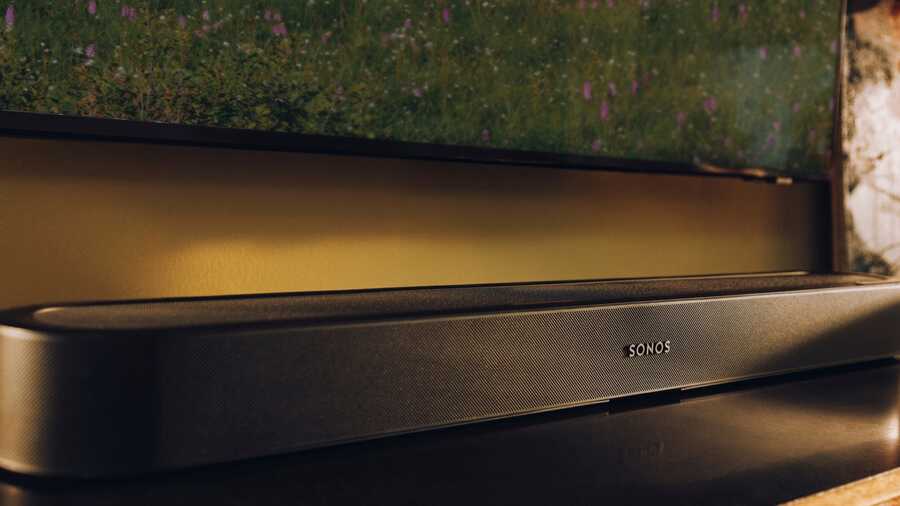
For the first time, a Beam has dedicated upward-firing drivers. The Beam Ultra is a new compact soundbar that Sonos positions between the Beam (Gen 2) and the larger Arc Ultra, with pre-orders open ahead of an estimated 29 September 2026 shipping date in the United States.
The Beam Ultra is priced at $699 in the US. Sonos is offering it in matte black and white, and the product is designed to work as a self-contained TV speaker before being expanded with a subwoofer or surround speakers. That makes the announcement relevant beyond the Sonos ecosystem itself: the company is trying to make a more convincing Atmos starting point without moving into the size or price class of its flagship bar.
A real change to the Beam's speaker layout
The most important hardware change is the acoustic architecture. Sonos lists nine Class-D digital amplifiers, five tweeters and four low-profile woofers. Two of the tweeters fire upward through directional horns, while two side-firing mid tweeters are used to create stereo separation around the front of the bar. The remaining forward-firing mid tweeter is intended to anchor the centre image, particularly for dialogue.
Together, Sonos describes the Beam Ultra as a 7.1.2-channel Dolby Atmos soundbar. The two height channels are the key difference from the Beam (Gen 2), which relied on processing rather than dedicated upward-firing drivers for its Atmos presentation. The hardware does not guarantee the same result in every room: ceiling height, ceiling material, seating position and the bar's placement will all affect the reflected height information. It does give the new model a more direct route to an overhead effect.
The bar measures 29.53 inches wide, 2.56 inches high and 4.13 inches deep, with a listed weight of 6.35 pounds. Sonos has kept the design low enough to sit beneath a television or be wall-mounted, which matters for a compact bar: a taller cabinet could improve driver volume, but it could also obstruct the lower edge of a screen.
Dialogue processing is adjustable rather than simply automatic
Sonos is also making dialogue clarity a central part of the Beam Ultra's feature set. AI Speech Enhancement detects human voices and offers four selectable levels in the Sonos app. The adjustment is useful in principle because not every room or soundtrack needs the same amount of processing. A quiet room may benefit from a lighter setting, while a reflective living room or an effects-heavy action film may justify more assistance.
The company also includes Night Sound, which reduces the intensity of loud sounds while making quieter details easier to hear. Trueplay room tuning remains part of the package and is listed as compatible with both iOS and Android devices. These are convenience features rather than replacements for sensible speaker placement, but they address common reasons people choose a soundbar in the first place: limited space, changing listening levels and dialogue that disappears when a soundtrack becomes busy.
Early listening reports from What Hi-Fi? and TechRadar describe a wider, more room-filling presentation from early demonstrations, with clear vocals and stronger bass than the smaller Beam. Those are first impressions from show demonstrations, not verdicts from a production unit in a controlled room.
Built to be the centre of a larger system
The Beam Ultra can be used on its own, but Sonos is clearly selling it as the centre of a modular system. Owners can add a Sonos subwoofer and rear speakers, while the product page also lists Sonos Play or Move 2 portable speakers as possible rear surrounds. The appeal is practical: those speakers can be used around the home when the TV is off, instead of remaining permanently tied to the cinema position.
Sonos also lists TV Audio Swap, which sends TV audio to compatible Sonos headphones. That is a niche feature, but it fits the Beam Ultra's broader design goal: one compact bar that can adapt to different listening situations instead of requiring a separate solution for late-night viewing.
Connectivity is centred on HDMI eARC/ARC, with Wi-Fi 6, Bluetooth 5.3 and Apple AirPlay 2 also supported. The bar includes a USB-C port, although Sonos describes that connection as requiring a separate Line-In or Combo Adapter for auxiliary audio or wired networking. The published format list covers Dolby Atmos, Dolby Digital, Dolby TrueHD, multichannel PCM and DTS Digital Surround. What Hi-Fi? reports that DTS:X is not supported, so buyers whose libraries or playback chain rely on that format should treat the Beam Ultra as an Atmos-focused product rather than a universal codec solution.
None of this makes it equivalent to a conventional AVR system with speakers positioned around and above the seating area. The Beam Ultra remains a front-heavy, compact solution whose performance will be shaped by the room, and the $699 bar does not include a subwoofer or rear speakers; expanding the system quickly moves the total cost upward. Sonos has added the hardware for a more direct Dolby Atmos presentation, kept the bar compact and given owners several ways to build outward from it later.
Related Reading
XGIMI Unveils HORIZON 30 Series: 4K at 120Hz, Dual Iris Technology, and Up to 10,000:1 Native Contrast
XGIMI unveils the HORIZON 30 Pro, Max, and Ultra Max with RGB triple laser, 4K 120Hz, Dual Iris technology, and major contrast improvements.
Apple Music Hall Will Stream Concerts Globally From a 48-Speaker Spatial Audio Venue
Apple's new 600-capacity London venue combines Spatial Audio production, multicamera capture and global livestreaming, but home playback formats remain unannounced.
Epson Brings Three 4K Laser Projectors to the US From $1,999
The Home Cinema LS5000, LS6000 and short-throw LS7500 combine 3LCD laser engines, 4K/120Hz input and prices from $1,999.99.