Projection has not lost the big-screen argument, it has lost the middle
Past 120 inches nothing touches projection on cost per inch; below 100 inches in daylight it has lost. Robert Heron's AVNation crossroads piece, and where the numbers land.
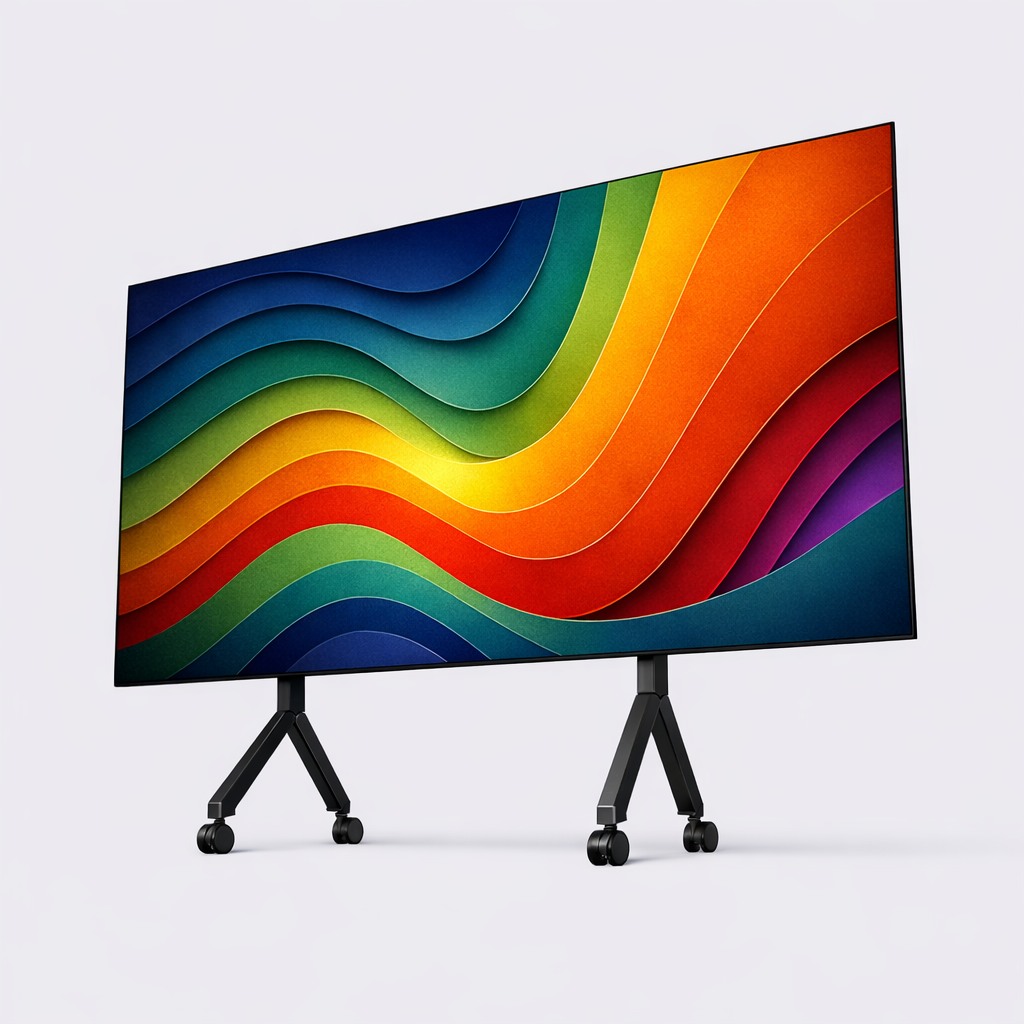
Epson, a projector company, now sells an LED wall, and Robert Heron reads that as good news for projection. Writing for AVNation on 24 July 2026 in "Projection at a Crossroads: The 2026 Turning Point", he argued that the large-display market is diversifying rather than consolidating: direct-view LED, projection and large flat panels have each found defensible ground, and Epson launching its own all-in-one dvLED line is a sign of a widening market rather than of projection running out of road.
His evidence bears repeating. Direct-view LED specifications that carried six-figure prices a few years ago now appear in five-figure products. Large LCD and OLED televisions in the 97 to 130 inch range have improved sharply in colour volume, luminance and HDR. Projection has moved too, with RGB triple-laser engines covering BT.2020, dynamic contrast ratios quoted between 6,000:1 and 10,000:1, and new Texas Instruments controllers enabling 1ms input lag at 240Hz.
Epson's entry is the concrete anchor. The LE-C1 series, announced on 3 June 2026, comprises the 135-inch LE-C1135 and 162-inch LE-C1162 in Full HD plus the 135-inch 4K LE-C14K135, all rated at 600 nits, built on COB rather than SMD packaging and deliberately shipped without an operating system. Epson has not published prices.
Where projection still wins: cost per diagonal inch
Our own position starts with the arithmetic, because it is not close. During the June sales, Dangbei's 4K DBOX02 laser projector sold at 949 dollars against a 1,899 dollar list, and the manufacturer claims an image up to 200 inches. Hisense's 100-inch 100U65QF mini-LED television, one of the cheaper routes to a three-figure diagonal, has traded at 1,497.96 dollars this year. A 135-inch dvLED panel sits in five figures.
Past roughly 120 inches, no other technology is within an order of magnitude of projection on cost per diagonal inch, and nothing suggests that changes soon. Projection also keeps three advantages unrelated to price: it disappears when switched off, it can sit behind an acoustically transparent screen with the speakers where they belong, and it can be installed and removed without construction work. A 162-inch LED wall is a building project. A 150-inch masked screen is a weekend.
Where projection has lost ground
Below about 100 inches in a room with daylight, projection has lost, and pretending otherwise does buyers no favours. A cheap large panel is brighter, simpler, needs no screen, no throw distance and no light control, and now costs less than a mid-range projector plus a decent screen.
The bigger retreat is in the professional middle. Interactive flat panels took the classroom, and all-in-one LED is taking the meeting room, precisely because "set it and forget it" beats lamp schedules, filter cleaning and throw calculations for facilities teams. Epson building an operating-system-free dvLED display for education and corporate rooms is not a hedge, it is a read on where that segment is going.
The room decides, not the technology
The useful question is no longer which technology wins but which constraint dominates. Ambient light and simplicity point to a panel. Space and permanence point to dvLED. Size and cost point to projection. Heron is right that these coexist, but coexistence is not symmetry: projection is being pushed towards the ends of the range, very large and very cheap, and squeezed out of the comfortable middle where the volume used to be.
Brightness is the weak point in every version of this comparison, his and ours. The Epson panels are specified at 600 nits, a figure with no clean equivalent in projector lumens, and the 6,000:1 to 10,000:1 contrast ratios are dynamic numbers rather than on and off ones. Until the same content is put up in the same room on all three, the crossroads argument rests on specifications that do not line up against each other.
Sources
- https://www.avnation.tv/2026/07/24/projection-at-a-crossroads-the-2026-turning-point/
- https://news.epson.com/news/le-c1-series-dvled
- https://news.epson.com/news/le-c1-series-dvled-shipping
- https://www.globenewswire.com/news-release/2026/06/23/3315969/0/en/skip-the-tv-upgrade-dangbei-s-prime-day-deals-put-a-4k-home-cinema-on-your-wall-for-up-to-50-off.html
- https://www.pcguide.com/deals/massive-hisense-100-inch-mini-led-tv-tumbles-back-to-its-lowest-price-again-with-amazon-limited-time-deal/
Related Reading
XGIMI Unveils HORIZON 30 Series: 4K at 120Hz, Dual Iris Technology, and Up to 10,000:1 Native Contrast
XGIMI unveils the HORIZON 30 Pro, Max, and Ultra Max with RGB triple laser, 4K 120Hz, Dual Iris technology, and major contrast improvements.
Apple Music Hall Will Stream Concerts Globally From a 48-Speaker Spatial Audio Venue
Apple's new 600-capacity London venue combines Spatial Audio production, multicamera capture and global livestreaming, but home playback formats remain unannounced.
Epson Brings Three 4K Laser Projectors to the US From $1,999
The Home Cinema LS5000, LS6000 and short-throw LS7500 combine 3LCD laser engines, 4K/120Hz input and prices from $1,999.99.