First HDMI 2.2 Ultra96 devices are now expected in 2027
HDMI Licensing Administrator says FRL2 silicon starts sampling during 2026 and the first 96Gbps products land in 2027, which keeps projectors on HDMI 2.1 for another cycle.
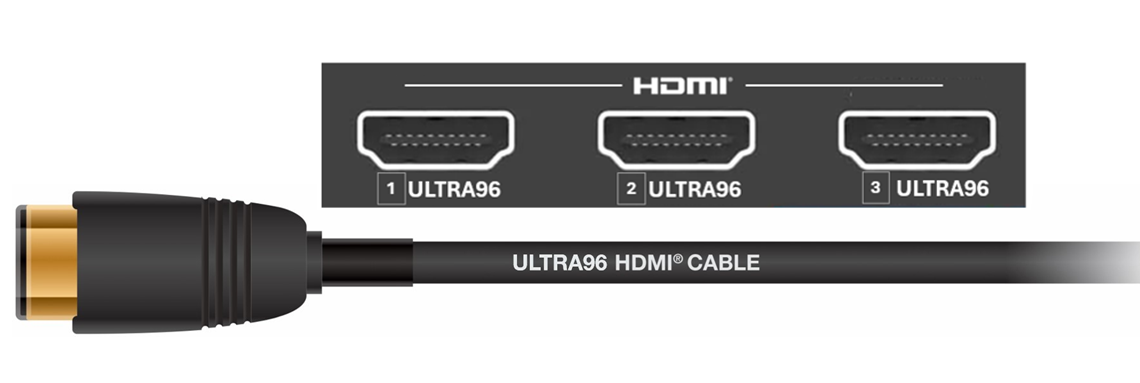
The 96Gbps interface is a 2027 product, not a 2026 one
HDMI Licensing Administrator has put a date on the gap between specification and hardware. Speaking at Computex 2026, president and chief executive Rob Tobias said: "We're hearing chip manufacturers will start to sample their FRL2 chips this year. And so we should start to see some 96 or up to 96 gigabit HDMI 2.2 products next year."
That is a two-year lag from specification to shipping silicon. HDMI 2.2 was announced in January 2025, and devices carrying its full bandwidth are now a 2027 proposition. Ultra96-certified cables should arrive sooner, possibly before the end of 2026, so the accessory will again reach shops before anything can use it.
What Ultra96 actually promises
The branding needs care. HDMI's own documentation describes Ultra96 as "a feature name that manufacturers are encouraged to use to indicate a product supports a maximum of 64Gbps, 80Gbps or 96Gbps bandwidth in compliance with the HDMI 2.2 Specification". An Ultra96 port is therefore not a guarantee of 96Gbps but of one of three tiers, and the buyer has to read the spec sheet to learn which.
The cable rules are simpler. The existing Ultra High Speed HDMI cable tops out at 48Gbps, so any device claiming Ultra96 needs the new Ultra96 cable to reach its rated bandwidth. HDMI 2.2 also adds the Latency Indication Protocol, intended to improve lip sync across multi-hop chains that route video through an AV receiver or soundbar.
Projectors stay on HDMI 2.1 for another cycle
For projector buyers this is a non-event dressed as news, and that is the useful part. Nothing in the current projector market is bandwidth-starved at the top end. JVC's DLA-NZ800 already runs 48Gbps HDMI 2.1 inputs that accept 8K/60p and 4K/120p, which is more than its imaging chain needs: it uses three native 4K D-ILA devices and generates its 8K grid by shifting pixels, not by displaying 8K natively.
That is the structural point. HDMI 2.2's headroom targets formats such as uncompressed 4K/240 and 8K/60 at 4:4:4 in 10-bit and 12-bit, plus 8K/240, 10K/120 and 12K/120. No consumer projector imager can resolve or refresh near that. A 4K DLP or D-ILA panel at 120Hz is the category ceiling, and light output, contrast and lens resolution constrain perceived detail long before the interface does.
Where the ambition actually sits
Two areas could use the bandwidth sooner. High-refresh gaming is one: if a projector ever ships with a 4K imager driven at 240Hz, HDMI 2.1 would need Display Stream Compression to feed it and HDMI 2.2 would not. The other is commercial and simulation work, where multi-projector rigs and large-format signage genuinely consume bandwidth. HDMI's own materials point at AR, VR, medical imaging and signage rather than home cinema.
Native 8K projection remains the furthest-off ambition, and bandwidth is not what is blocking it. Building an 8K imaging device with usable contrast, then putting enough light through a lens that can resolve it, is the harder problem.
Do not buy for an upgrade path that does not exist
Buying a projector now on the expectation of an HDMI 2.2 upgrade path makes little sense. No projector with an Ultra96 port has been announced, projectors have historically adopted new HDMI generations later than televisions, and the sources that would drive them are 2027 hardware at the earliest.
The practical checks remain unchanged: does the projector accept 4K/120 if you game, does it pass the HDR formats your sources output, does eARC work with your audio chain, and is measured input lag acceptable in game mode. None of those depend on 96Gbps.
Unremarkable for the standard, awkward for cable marketing
The slip to 2027 is unremarkable for the specification and awkward for cable marketing. Ultra96 cables will be sold through a year in which no display can use them, and the tiered feature name invites the same confusion HDMI 2.1's optional-feature structure already caused. Projector owners can ignore it for at least one more product cycle.
Sources
- https://www.hdmi.org/spec2sub/ultra96
- https://www.hdmi.org/blog/detail/169
- https://www.tweaktown.com/news/112269/hdmi-2-2-products-are-coming-in-2027-as-chip-makers-begin-sampling-frl2-silicon-this-year/index.html
- https://videocardz.com/newz/first-96-gbps-hdmi-2-2-products-expected-in-2027
- https://uk.jvc.com/projectors/4k/DLA-NZ800BE/
Related Reading
XGIMI Unveils HORIZON 30 Series: 4K at 120Hz, Dual Iris Technology, and Up to 10,000:1 Native Contrast
XGIMI unveils the HORIZON 30 Pro, Max, and Ultra Max with RGB triple laser, 4K 120Hz, Dual Iris technology, and major contrast improvements.
Apple Music Hall Will Stream Concerts Globally From a 48-Speaker Spatial Audio Venue
Apple's new 600-capacity London venue combines Spatial Audio production, multicamera capture and global livestreaming, but home playback formats remain unannounced.
Epson Brings Three 4K Laser Projectors to the US From $1,999
The Home Cinema LS5000, LS6000 and short-throw LS7500 combine 3LCD laser engines, 4K/120Hz input and prices from $1,999.99.