Dolby Vision 2 ships on Hisense TVs first, and projectors are waiting on silicon
Hisense is first to ship Dolby Vision 2 by firmware update, but no projector has been announced with support, and the reason is which chip the format lives in.
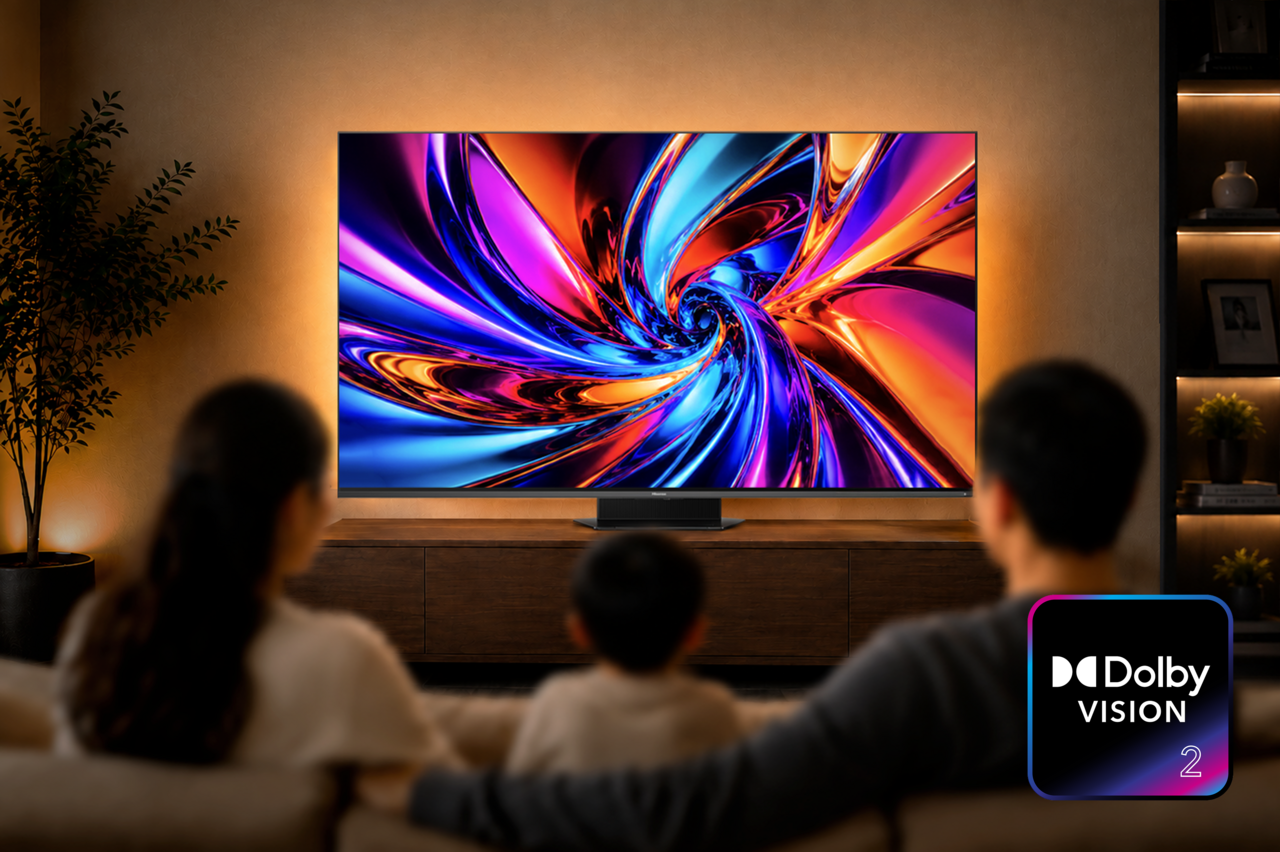
The first Dolby Vision 2 devices are televisions, and only televisions
Dolby and Hisense confirmed on 6 August 2026 that Dolby Vision 2 has started rolling out as a free firmware update. The first models are Hisense's 2026 UX, UR9, UR8 and U7 sets, sold as the U7 Pro in Europe, the Middle East and Central and South America, on both Google TV and VIDAA. More models follow across North America, Europe and Asia-Pacific, and these four are also the first to get the Max tier.
That makes Hisense the first brand to ship the format. It also makes the omission obvious: there is no projector on the list, and Dolby has not announced Dolby Vision 2 for any projector.
What Dolby Vision 2 actually changes
Dolby Vision 2 is built around a new image engine rather than a new container. The base tier adds Content Intelligence, which uses embedded metadata to adapt the picture to what is playing, plus an intensity slider for dialling depth and richness up or down to suit reflections and off-axis seating.
The premium tier, Dolby Vision 2 Max, is where the interesting parts sit. Authentic Motion is a creative-controlled judder reduction tool intended to smooth cadence without the interpolated look of aggressive frame generation. Light Sense 2 continuously adapts the picture to room lighting, and there is a set of pro-level controls for enthusiasts.
Dolby has named CANAL+, iQIYI and Peacock as content partners. Nothing in the announcement mentions projectors or disc players.
Why the format lands on TVs first
Dolby Vision 2 is implemented in silicon. MediaTek announced in September 2025 that its Pentonic 800, with the MiraVision Pro picture engine, is the first smart TV chipset to support Dolby Vision 2, and named Hisense as the first brand to market. That is a television SoC, sold into television platforms.
Projectors do not run flagship TV chips. Even the projectors that support the original Dolby Vision use projector-class application processors, and no projector-class SoC has been announced with Dolby Vision 2. Until a chip vendor ships one and a projector brand licenses the tier, the format cannot appear on a projector, however good the optics are.
Dolby Vision 2 is not a firmware flag a manufacturer can enable at will. Hisense's rollout is a software update precisely because the capable hardware was already inside those sets.
Players and discs are a different problem
Jonas Klittmark, director of business strategy at Dolby, told press that existing UHD Blu-ray players would not need new hardware, because the metadata travels over HDMI, only a software update to configure them correctly. Feasible, then, but Sony has said it has no current plans to issue such an update.
A projector owner therefore faces two gaps: no Dolby Vision 2 in projector silicon, and no confirmed disc player either. Built-in streaming apps are the more likely first route, and that route still needs the display-side engine.
What Dolby has and has not said
Asked at IFA 2025 about displays beyond televisions, Dolby's Aaron Dew, senior product manager for home entertainment, said there are "a lot of other kinds of displays, and there's more to talk about in the future". A hint, not a roadmap: no projector model, no chipset and no date.
Nothing here devalues a projector bought this year
Nothing here devalues a projector bought this year. Dolby Vision continues, the content is the same, and a well-tuned HDR10 implementation on a bright laser projector still beats a badge on a dim one. Dolby Vision 2 will reach projectors when projector SoCs arrive with it built in, which puts any credible announcement a product cycle away rather than a firmware update away. Treat a projector marketed as Dolby Vision 2 ready before then with scepticism, and ask which chip it runs.
Sources
- https://investor.dolby.com/news-events/financial-news/news-details/2026/Dolby-Vision-2-Arrives-Bringing-Dolbys-Most-Advanced-Picture-Experience-Yet-to-Hisense-TVs/default.aspx
- https://news.dolby.com/en-WW/268998-dolby-vision-2-arrives-bringing-dolby-s-most-advanced-picture-experience-yet-to-hisense-tvs/
- https://www.mediatek.com/tek-talk-blogs/mediatek-pentonic-800-first-with-dolby-vision-2-for-smart-tvs
- https://www.svconline.com/proav-today/dolby-confirms-dolby-vision-2-can-work-on-existing-uhd-players
- https://www.techradar.com/televisions/home-theater/sorry-home-theater-fans-dolby-vision-2-hdr-isnt-confirmed-for-4k-blu-ray-or-projectors-yet
Related Reading
XGIMI Unveils HORIZON 30 Series: 4K at 120Hz, Dual Iris Technology, and Up to 10,000:1 Native Contrast
XGIMI unveils the HORIZON 30 Pro, Max, and Ultra Max with RGB triple laser, 4K 120Hz, Dual Iris technology, and major contrast improvements.
Apple Music Hall Will Stream Concerts Globally From a 48-Speaker Spatial Audio Venue
Apple's new 600-capacity London venue combines Spatial Audio production, multicamera capture and global livestreaming, but home playback formats remain unannounced.
Epson Brings Three 4K Laser Projectors to the US From $1,999
The Home Cinema LS5000, LS6000 and short-throw LS7500 combine 3LCD laser engines, 4K/120Hz input and prices from $1,999.99.