DATALAND shows how projection can become architecture
ProjectorCentral's look inside DATALAND's Data Pavilion, powered by 84 Epson 4K laser projectors, explores projection as an architectural storytelling tool rather than a conventional display.
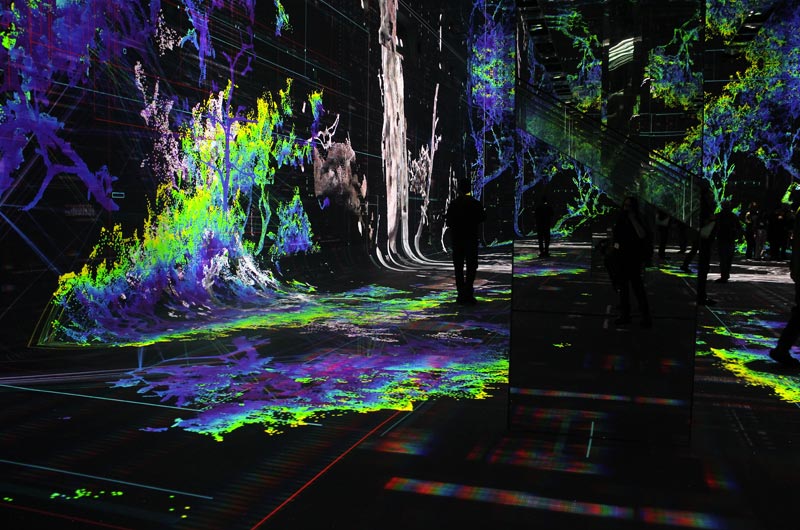
When the projected image defines the space
ProjectorCentral's visit to DATALAND's Data Pavilion is a useful case study in immersive design. DATALAND, a 25,000 square-foot museum built around the artist Refik Anadol's AI-driven work, opened in the Grand LA development in downtown Los Angeles' Grand Avenue Cultural District, alongside neighbours including the Walt Disney Concert Hall, The Broad and MOCA. Its inaugural exhibition, Machine Dreams: Rainforest, runs from 20 June 2026 to 31 January 2027, according to coverage from Blooloop. In projects like this, projection is not a rectangular image placed on a wall. It becomes part of the architecture, helping visitors understand data, motion and scale by surrounding them with visual information.
That approach puts enormous pressure on the complete system. The content must be designed for the surface, the projectors must be positioned and blended accurately, and the room's materials must cooperate with the image. A small geometry error or an unexpected reflection can be far more distracting than it would be on a normal screen.
The scale of the projection system
According to reporting from AV Interactive, the Data Pavilion alone uses 84 Epson 4K laser projectors, each rated at 20,000 lumens, combining for more than 8 million pixels. Across DATALAND's five galleries as a whole, the projection, LED and display systems together produce what its operators describe as 1.5 billion total pixels, drawing on the 84 Epson units alongside 28 LG displays and more than 1,500 custom LED panels spanning over 300 square meters. Multi-projector blending across the Data Pavilion's curved surfaces is handled by Scalable's camera-based alignment technology, which captures the projected image and automatically aligns, blends and colour-matches every projector's output to remove visible seams, a technique long used in planetariums but rarely deployed at this density in a public art museum. Blooloop's reporting adds a 250-speaker spatial audio system from L-Acoustics, and that the display and audio infrastructure is designed to respond to visitor biosensor data in real time rather than simply loop fixed content.
Experience design needs operational design
Immersive installations look effortless only when the operational work has been done well. Teams need a plan for calibration, projector access, content updates, power, cooling and fallback modes, and for how the experience works in daylight, with crowds, and when one part of a multi-projector system is unavailable. At the scale of 84 projectors feeding one continuous canvas, a single unit falling out of calibration has to be handled without visitors noticing a seam or a dark patch in the image.
DATALAND's founders have described the intent as making the building's infrastructure disappear into the architecture, turning the structure itself into an active participant in the visitor experience rather than a neutral shell around the artwork. That framing only holds up if the plumbing behind it, projector placement, blending software and content pipeline, stays invisible during normal operation.
The questions that matter over months rather than minutes
DATALAND is a permanent installation rather than a product launch, so there is no single spec sheet to hold it to, but the same practical questions apply as with any large-scale projection-mapped space: how consistent brightness and colour remain across 84 units over months of daily operation, and how quickly a failed projector can be swapped without visitors noticing an outage.
Planning belongs inside the creative process
DATALAND is a reminder that projection remains one of the most flexible visual technologies available. It can make a building itself tell a story, but only when technical planning, projector count, blending software, power and maintenance access, is treated as part of the creative process rather than an afterthought.
Sources
Related Reading
XGIMI Unveils HORIZON 30 Series: 4K at 120Hz, Dual Iris Technology, and Up to 10,000:1 Native Contrast
XGIMI unveils the HORIZON 30 Pro, Max, and Ultra Max with RGB triple laser, 4K 120Hz, Dual Iris technology, and major contrast improvements.
Apple Music Hall Will Stream Concerts Globally From a 48-Speaker Spatial Audio Venue
Apple's new 600-capacity London venue combines Spatial Audio production, multicamera capture and global livestreaming, but home playback formats remain unannounced.
Epson Brings Three 4K Laser Projectors to the US From $1,999
The Home Cinema LS5000, LS6000 and short-throw LS7500 combine 3LCD laser engines, 4K/120Hz input and prices from $1,999.99.