Dangbei launches the RX10 laser gimbal and a brighter D7X Pro, and CVIA lumens explain the numbers
Dangbei's RX10 gimbal projector arrived in China at 5,499 yuan with 1,200 CVIA lumens, while the refreshed D7X Pro claims 1,700 CVIA for less money, which makes the unit worth understanding.
Two China-market launches, and one measurement unit doing the heavy lifting
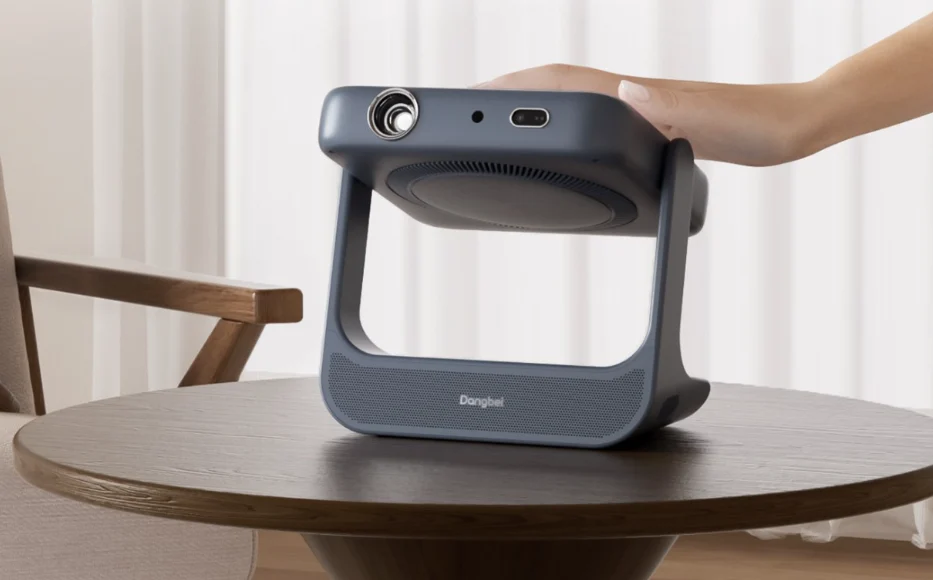
Dangbei has put the RX10 on sale in China, a 1080p ALPD laser projector built around a motorised gimbal, listed on JD.com at 5,499 yuan, roughly $820. Days earlier the company refreshed its 4K model as the D7X Pro Ultra Bright Edition, quoting 1,700 CVIA lumens at 3,799 yuan, about $565.
Both are China-only for now, with no Western pricing or release date. The pairing is instructive because the cheaper projector is the brighter and higher-resolution one, and because every brightness figure here uses a unit that does not map onto the ANSI and ISO numbers quoted elsewhere.
What the RX10 is
The RX10 uses ALPD laser illumination with a 0.33-inch DMD at native 1080p, accepting 4K input, behind a fixed 1.2:1 lens. Dangbei quotes 1,200 CVIA lumens. The defining feature is a 225-degree gimbal, enough to aim at a wall or tip the lens back to the ceiling without propping the body on anything.
Processing is a MediaTek MT9669 with 3GB of RAM and 32GB of storage running Dangbei OS 5.0, with HDR10, HLG and MEMC. Connectivity covers Wi-Fi 6, Bluetooth 5.0 and HDMI 2.1 with eARC, and two 6W speakers sit in the base rather than the moving head. The 2.1kg unit draws about 90W from a 110W adapter, and can run from a power bank supplying at least 45W over USB Power Delivery, with Dangbei's own cable.
The D7X Pro refresh is the better spec sheet
The D7X Pro Ultra Bright Edition uses a pure RGB triple-laser engine Dangbei calls QuaLas 42 on a 0.39-inch DMD, so the quoted 4K output points to pixel shifting rather than a 4K imager. Dangbei's own store lists 1,700 CVIA and 1,900 ISO lumens with an MT9681 processor, plus claims of 50,000:1 dynamic contrast, 110 per cent BT.2020, 99 per cent DCI-P3 and delta E below 1. There is a 0.98:1 to 1.3:1 optical zoom and a 145-degree gimbal.
So the cheaper model is brighter, claims wider colour, adds optical zoom and reaches 4K. The RX10's premium buys the larger gimbal, the enclosure and the audio placement, not image performance.
What CVIA lumens actually are
CVIA lumens come from a China Video Industry Association group standard for projector light output, introduced in October 2022 to bring order to brightness claims in that market. Like ANSI and ISO 21118, it averages nine screen zones. What it adds are constraints on the state the projector must be in while measured: colour temperature within 6,000K to 18,000K, colour deviation held to Duv of 0.015 or less, and production units required to reach at least 80 per cent of the rated figure.
Why the unit matters when you compare
Those constraints are the point. A projector cannot be measured in a green-tinted maximum-output mode and still qualify, which is exactly how inflated claims have historically been produced.
The consequence shows up in Dangbei's own numbers. The same D7X Pro is rated at 1,700 CVIA and 1,900 ISO: about 12 per cent apart, on one projector, to two standards. There is no official conversion between them, so treating a CVIA figure as interchangeable with an ANSI number is guesswork. Compare CVIA with CVIA, and treat any single-number brightness claim as a starting point rather than a result.
Two unmeasured projectors, and a question of availability
Neither product has been measured independently. For the RX10: how much of the gimbal's range stays usable before automatic keystone correction discards resolution, and how an ALPD engine at 1,200 CVIA lumens copes with daylight. For the D7X Pro, the 50,000:1 figure is dynamic rather than native, and the colour claims need to survive calibration.
The wider caveat is availability. Dangbei's Chinese lineup does not always cross over, and the RX10 does not appear on the company's global site. Treat both as signals of where the category is going rather than products buyers elsewhere can order.
Sources
- https://shop.dangbei.com/
- https://www.gizmochina.com/2026/08/22/dangbei-rx10-projector-launched-specs-price/
- https://www.gizmochina.com/2026/08/20/dangbei-d7x-pro-super-bright-edition-4k-projector-launched-specs-price/
- https://www.projector1.com/dangbei-rx10-5499-yuan-gimbal-alpd-laser/
- https://www.itbear.com.cn/html/2026-08/1502716.html
- https://awolvisionpro.com/blogs/awol-vision-blog/understanding-lumens-ansi-iso-led-cvia
- https://www.tvsbook.com/threads/what-is-cvia-lumen-cvia-lumen-vs-ansi-lumen-comparison.8134/
Related Reading
XGIMI Unveils HORIZON 30 Series: 4K at 120Hz, Dual Iris Technology, and Up to 10,000:1 Native Contrast
XGIMI unveils the HORIZON 30 Pro, Max, and Ultra Max with RGB triple laser, 4K 120Hz, Dual Iris technology, and major contrast improvements.
Apple Music Hall Will Stream Concerts Globally From a 48-Speaker Spatial Audio Venue
Apple's new 600-capacity London venue combines Spatial Audio production, multicamera capture and global livestreaming, but home playback formats remain unannounced.
Epson Brings Three 4K Laser Projectors to the US From $1,999
The Home Cinema LS5000, LS6000 and short-throw LS7500 combine 3LCD laser engines, 4K/120Hz input and prices from $1,999.99.