Christie takes the CP4420m-RGBH to China and puts the argument on lumens per watt
At BIRTV 2026 in Beijing the CP4420m-RGBH hybrid laser cinema projector is being sold on 14.7 lumens per watt and a claimed 35 per cent lower running cost.
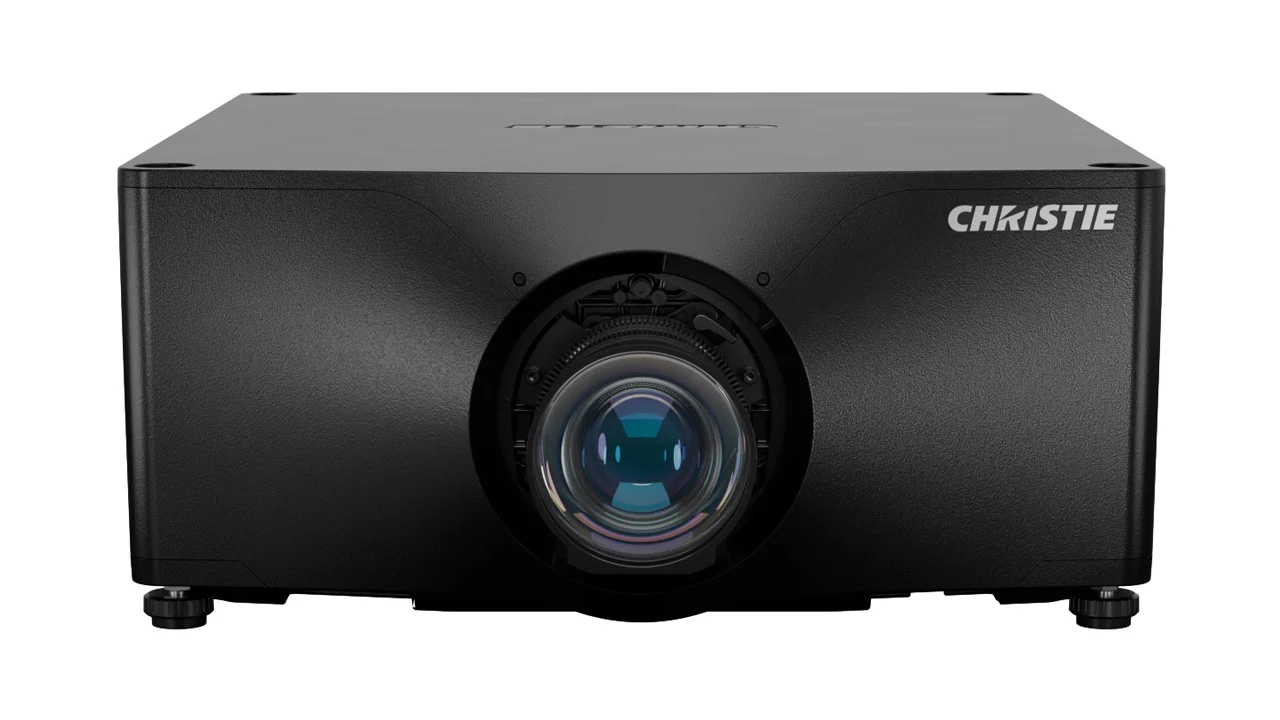
The CP4420m-RGBH arrives in China with an electricity argument rather than a picture-quality one. Christie confirmed on 11 August 2026 that the hybrid laser cinema projector would make its China debut at BIRTV, the Beijing International Radio, TV and Film Exhibition, held from 19 to 22 August at the China International Exhibition Center, running with Christie's CineLife+ IMB-S4 integrated media block for DCI-compliant feature playback.
Christie also brought the CP4435-RGB, a 35,000-lumen pure RGB laser model for screens up to 27 metres, and the CP2411-RBe, an 11,000-lumen 2K projector on CineLife+2K electronics. That lineup is the useful context: the CP4420m-RGBH is deliberately positioned between the two.
The specification, without the marketing
The CP4420m-RGBH is rated at up to 20,000 lumens from a 4K 0.98-inch three-chip SST DMD at 4096 by 2160, using Christie's Phazer illumination, which combines RGB pure laser with phosphor conversion. Christie quotes DCI-P3 coverage, contrast up to 6,000:1 measured full field on and off, a light source rated beyond 50,000 hours, screen widths up to 19 metres, nominal power draw of 1,360W, under 47 dBA of noise and a maximum weight of 60kg.
Two figures deserve care. Full field on/off contrast is the friendliest way to measure a projector and says little about intra-frame contrast on real content. The 50,000-hour rating is a light source specification, not a promise about calibrated performance at year ten.
14.7 lumens per watt is the sales argument
The number Christie leads with is 14.7 lumens per watt, alongside claims of being 40 per cent more efficient than competing models and running at roughly 35 per cent lower operating cost on average than the leading competitor in its class. For comparison, Christie quotes 9.4 lumens per watt for the 2K CP2411-RBe, with 170 per cent better energy efficiency than a comparable xenon system and up to a 59 per cent reduction in total cost of ownership.
Those are vendor claims against unnamed rivals, so treat the percentages as positioning. The underlying metric is not marketing. For an exhibitor, lumens per watt sets the electricity bill, the heat load the booth's cooling must remove, and how hard the light source is driven to hit target brightness, which in turn drives how quickly it dims.
Laser primaries where colour matters, phosphor for the rest
A pure RGB laser engine gives the widest gamut and the cleanest primaries, and costs the most per lumen because red laser diodes are expensive. Phosphor conversion is cheap and efficient at generating bulk luminance but narrower in gamut on its own.
A hybrid keeps laser primaries where colour accuracy matters and leans on phosphor for the rest of the light budget: a compact single-chassis projector that still meets DCI-P3 while landing well below a pure RGB system on capital cost. Christie does not publish how the luminance is divided between the two paths, which is the detail that would let anyone judge the colour trade-off independently.
A market of mid-size auditoriums
China has an enormous number of screens, a large installed base of xenon and first-generation laser projectors, and a great many mid-size auditoriums rather than flagship premium large-format rooms. That is the market a 20,000-lumen hybrid aimed at 19-metre screens is built for. Han Kim, Christie's vice president of sales for Asia-Pacific, framed the show around helping customers adapt to changing industry needs.
Christie has not published Chinese pricing, local availability dates or service terms, which are the three things that will decide whether the efficiency argument converts into orders. For home cinema readers the transferable point is the architecture: hybrid laser plus phosphor is becoming the cost-effective middle path in professional projection, and that thinking usually reaches premium consumer models a generation later.
Sources
Related Reading
XGIMI Unveils HORIZON 30 Series: 4K at 120Hz, Dual Iris Technology, and Up to 10,000:1 Native Contrast
XGIMI unveils the HORIZON 30 Pro, Max, and Ultra Max with RGB triple laser, 4K 120Hz, Dual Iris technology, and major contrast improvements.
Apple Music Hall Will Stream Concerts Globally From a 48-Speaker Spatial Audio Venue
Apple's new 600-capacity London venue combines Spatial Audio production, multicamera capture and global livestreaming, but home playback formats remain unannounced.
Epson Brings Three 4K Laser Projectors to the US From $1,999
The Home Cinema LS5000, LS6000 and short-throw LS7500 combine 3LCD laser engines, 4K/120Hz input and prices from $1,999.99.