BenQ's first RGB triple-laser projectors arrive with a walked-back Dolby Vision 2 claim
Two RGB triple-laser 4K projectors, the W4200 and TK715i, debuted at IFA 2026 alongside a Dolby Vision 2 claim that BenQ qualified within hours.
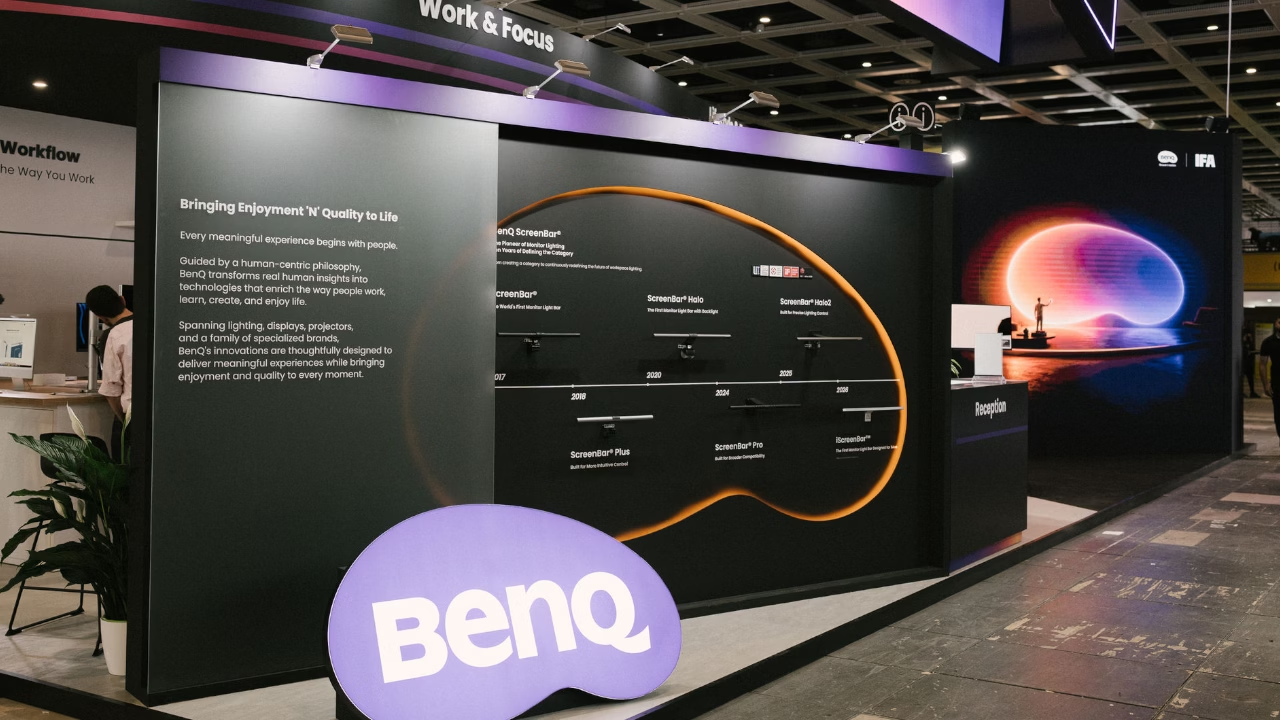
For a few hours on 4 September 2026 the BenQ W4200 was the world's first Dolby Vision 2 projector. Then it was not. The claim, made at IFA Berlin and qualified by BenQ within hours, travelled further than the actual news: the W4200 for dark-room home cinema and the TK715i for living rooms are the company's first models built around a true RGB triple-laser light source, replacing the 4LED engines BenQ has used across recent premium models.
The claim, and the correction
Several outlets covering the stand reported the W4200 as the world's first projector compatible with Dolby Vision 2, and the framing looked official rather than speculative. Clubic then reported that the company said support for Dolby Vision 2 was not guaranteed, and that only conventional Dolby Vision is confirmed.
The reason given is supply rather than engineering reluctance: Dolby Vision 2 decode silicon is being produced in small volumes and allocated to television makers first. That leaves the W4200 with HDR10, HDR10+, HLG and standard Dolby Vision, a strong list on its own, but not the first-in-the-world headline briefly attached to it. The corrected position promises Dolby Vision 2 neither at launch nor as a later firmware addition, and buyers should treat that as settled.
Prices and dates are still soft
BenQ's own IFA release names the W4200, TK715i and AK900ST without prices or dates. Show reporting points to a January 2027 European launch for both new laser models, with estimates of roughly €4,000 to €5,000 for the W4200 and about €1,500 to €1,800 for the TK715i. None of that is official, and one outlet placed the W4200 in December 2026 instead.
The W4200 is the dark-room model
The W4200 uses a 0.47-inch DLP chip with pixel shifting for 4K output, and a Nichia Qualas 42 RGB laser engine rated at 3,200 ANSI lumens with 99% DCI-P3 coverage. BenQ quotes 3,000:1 native contrast and a 5,000,000:1 dynamic figure, the latter being the usual marketing number rather than anything a reviewer will measure directly.
More interesting is the optical package: an all-glass, fully motorised lens with a 0.9 to 1.5 throw ratio, roughly 1.6x zoom, around 50% vertical lens shift, and a mechanical iris with three positions. Processing runs on a MediaTek MT9681 with BenQ's HDR-Pro 2.0 and AI contrast handling, plus Filmmaker Mode and IMAX Enhanced certification. There is no Google TV, which is deliberate: this model is pitched at users who bring their own source.
The TK715i takes the same engine to the living room
The TK715i shares the 3,200-lumen RGB laser engine and the 99% DCI-P3 claim, but adds Google TV, Chromecast, two HDMI 2.1 inputs with eARC and ALLM, a 30W USB-C port and 2x12W speakers. BenQ quotes 5ms input lag at 4K/60, a competitive figure in this class.
Both models also introduce a multi-stage de-speckle system, which matters more than it sounds. Visible speckle and coarse texture are the standing complaints against RGB laser projection, and a first-generation implementation is exactly where that should be scrutinised.
Sources
- https://www.benq.eu/en-eu/news/products/benq-unveils-new-visual-innovations-for-work-an-entertainment-at-ifa-2026.html
- https://www.clubic.com/actualite-628378-benq-w4200-le-premier-videoprojecteur-dolby-vision-2-ou-pas.html
- https://www.avcesar.com/ifa-26-benq-w4200-projecteur-dlp-4k-triple-laser-optique-motorisee-imax-enhanced-et-hdr-dolby-vision-48468
- https://www.avcesar.com/ifa-26-videoprojecteur-benq-tk715i-triple-laser-rvb-google-tv-et-5-ms-d-input-lag-48482
- https://blog.son-video.com/2026/09/ifa-2026-benq-devoile-ses-premiers-videoprojecteurs-4k-triple-laser/
- https://www.cowcotland.com/news/102297/ifa-2026-benq-presente-deux-nouveaux-videoprojecteurs-4k-rgb-laser.html
- https://www.ecranlarge.com/high-tech/actu/benq-w4200-ifa-2026
Related Reading
XGIMI Unveils HORIZON 30 Series: 4K at 120Hz, Dual Iris Technology, and Up to 10,000:1 Native Contrast
XGIMI unveils the HORIZON 30 Pro, Max, and Ultra Max with RGB triple laser, 4K 120Hz, Dual Iris technology, and major contrast improvements.
Apple Music Hall Will Stream Concerts Globally From a 48-Speaker Spatial Audio Venue
Apple's new 600-capacity London venue combines Spatial Audio production, multicamera capture and global livestreaming, but home playback formats remain unannounced.
Epson Brings Three 4K Laser Projectors to the US From $1,999
The Home Cinema LS5000, LS6000 and short-throw LS7500 combine 3LCD laser engines, 4K/120Hz input and prices from $1,999.99.