Fujifilm FP-ZUH12000 brings interchangeable lenses to bright 4K projection
Fujifilm's FP-ZUH12000 is a 12,000-lumen 4K interchangeable-lens projector aimed at demanding installations and flexible venue layouts.
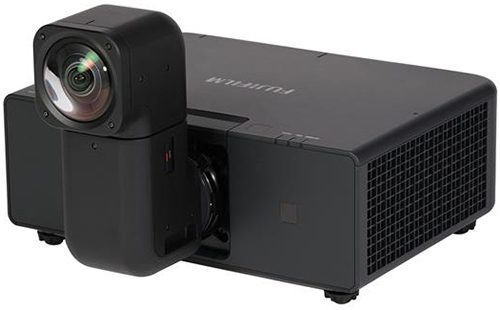
A high-brightness installation projector
Fujifilm's FP-ZUH12000 is not a living-room projector. It is a professional installation model designed for spaces where brightness, lens choice and placement flexibility matter more than plug-and-play streaming. Fujifilm says the projector supports 4K projection and reaches up to 12,000 lumens with the appropriate lens.
The headline feature is interchangeable lens support. That gives installers more control over throw distance and room geometry, which matters in museums, event spaces, education venues and commercial environments where the projector cannot always sit in an ideal location.
Why Fujifilm is interesting here
Fujifilm has a strong optical background, and its projector line has often leaned into lens engineering rather than just brightness. The FP-ZUH12000 continues that pattern. The available lens options include ultra-short-throw, short-throw and standard lens choices, giving the platform more deployment range than a fixed-lens projector.
For ProAV work, this can be more important than a single spec. If the lens is wrong, the installation becomes compromised before calibration even starts.
What should be tested
A meaningful evaluation would focus on lens sharpness, brightness uniformity, color behavior at high output, fan noise under real load and how easy the projector is to align. It would also be worth checking how well the image holds detail across different optional lenses.
The FP-ZUH12000 is another reminder that 4K projection is not only about home cinema. Large-format installations need high resolution too, especially when audiences stand close to the image or when text and fine detail are part of the content.
Fujifilm's FP-ZUH12000 is the kind of projector that only makes sense when viewed through an installation lens. The headline is not simply 4K and high brightness; it is the combination of a compact chassis, interchangeable lenses and Fujifilm's unusual folded optical design. That is valuable in venues where the projector cannot be placed in an ideal position but the image still has to land cleanly.
This is a different world from living-room projectors. Museum, event and simulation installs often need projection from odd angles, tight spaces or overhead positions. Lens flexibility and geometric control can matter more than app platforms or consumer HDR formats. Fujifilm's experience with optics gives the model a distinctive reason to exist.
The most useful tests would look at lens shift range, edge-to-edge sharpness with different lenses, brightness consistency and color matching in multi-projector setups. Installers will also care about control protocols, filter maintenance, heat and how easily the projector can be serviced once mounted.
For enthusiasts, the FP-ZUH12000 is not a home-cinema recommendation. It is still worth covering because professional installation products show how projection keeps solving spaces that flat panels cannot touch.
Related Reading
Leica Cine Compact 1 brings Leica optics to a smaller 4K laser projector
Leica's Cine Compact 1 is a compact 4K Triple RGB laser projector with Dolby Vision, VIDAA streaming, 360-degree setup and a €1,645 launch price.
Acer HL6820GTV brings 4K laser, Google TV and high-refresh gaming to EMEA
Acer's HL6820GTV is a 4K laser projector built around bright living-room use, Google TV, VRR support and fast 1080p gaming modes.
BenQ TK705i and TK705STi lean into plug-and-play 4K streaming
BenQ's TK705i and TK705STi pair 4K projection with Google TV, automatic setup tools, HDMI gaming features and two throw-distance choices.