AWOL Aetherion tries to solve the 200-inch UST sharpness problem
PixelLock, the alignment system on AWOL Vision's CES 2026 Aetherion Max and Pro, targets the edge softness that undoes 4K UST images pushed toward 200 inches.
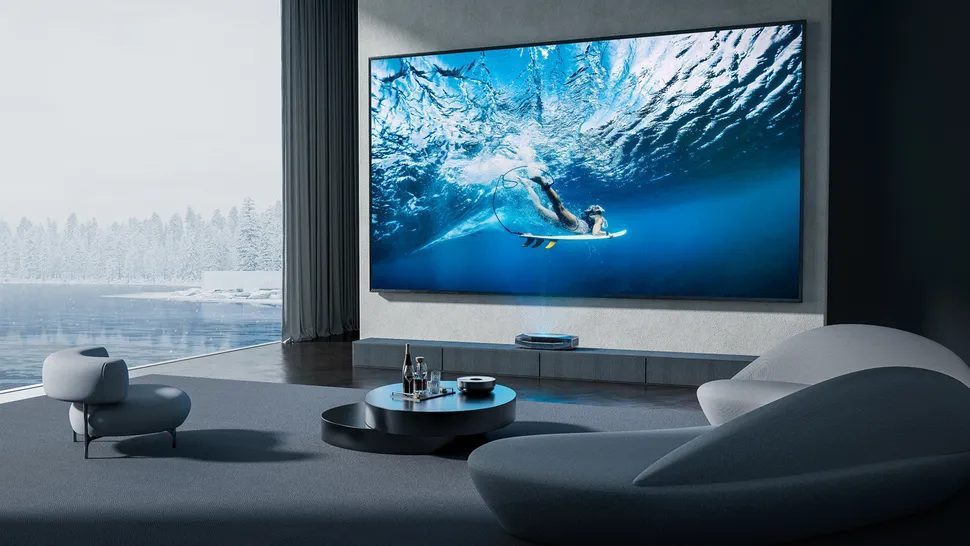
A 100-inch ultra-short-throw image can hide a soft corner. A 200-inch one cannot, and that is the problem AWOL Vision says PixelLock exists to solve. The alignment system is the headline claim on the Aetherion Max and Aetherion Pro, two premium UST projectors introduced at CES 2026 and aimed at very large living-room screens, where the company says it keeps a 4K image sharp even when pushed toward 200 inches.
The physics make it a big claim. UST projection is convenient because the projector sits close to the wall, but the image leaves the lens at an extreme angle, and any small geometry or alignment weakness shows at the edges of the screen. The larger the image, the harder geometry, focus and edge clarity are to hold. Wall flatness, screen tension, furniture placement and focus uniformity all become more demanding at that scale, which is why 200-inch UST claims often sound exciting and then collapse in a real room.
Edge focus, not another brightness number
Most UST marketing leads with brightness, screen size and smart TV software. In real rooms, edge focus and panel alignment are often more important. Fine text, game HUDs and 4K detail at the corners quickly reveal whether the optical system is keeping up, and PixelLock is interesting because it targets that specific weakness instead of adding another lumen figure. The promise is not simply a brighter laser TV but a UST platform on which very large screen sizes feel less compromised. If AWOL can make setup correction more stable without visible processing artefacts, Aetherion would be chasing a real advantage rather than a bigger number.
Grid patterns and a warm-up cycle will settle it
Repeatability comes first. Can the projector hold geometry after power cycles, and after being moved? Does the correction system preserve fine detail, or does it soften the image to hide alignment errors? Grid patterns, high-detail 4K material and off-axis viewing should be used to check edge sharpness, chromatic fringing, focus consistency and geometry at several screen sizes rather than one ideal demo setup, and again after warm-up.
Then comes ordinary picture evaluation, because a sophisticated alignment system counts for little if black level, HDR handling or fan noise are poor. Until that work is done, Aetherion is a promising idea rather than a solved category. The best outcome would be a projector that makes huge UST setups less fragile while still behaving like a strong everyday cinema display, and AWOL aiming at a real UST weakness is more meaningful than another vague "cinematic" launch.
Related Reading
XGIMI Unveils HORIZON 30 Series: 4K at 120Hz, Dual Iris Technology, and Up to 10,000:1 Native Contrast
XGIMI unveils the HORIZON 30 Pro, Max, and Ultra Max with RGB triple laser, 4K 120Hz, Dual Iris technology, and major contrast improvements.
Apple Music Hall Will Stream Concerts Globally From a 48-Speaker Spatial Audio Venue
Apple's new 600-capacity London venue combines Spatial Audio production, multicamera capture and global livestreaming, but home playback formats remain unannounced.
Epson Brings Three 4K Laser Projectors to the US From $1,999
The Home Cinema LS5000, LS6000 and short-throw LS7500 combine 3LCD laser engines, 4K/120Hz input and prices from $1,999.99.